
Introduction
Certain people have left a huge mark on history. Their actions and ideas changed everything. Think of the big names that shaped our world. That’s what we’re diving into.
This article covers some of the most influential people ever. We’ll talk about ancient rulers, religious leaders, scientific geniuses, and cultural icons. These are the people who made a real impact on humanity. Ready? Let’s go.
Table of Contents
- Julius Caesar: The Rise of the Roman Empire
- Confucius: Shaping Eastern Philosophy
- Alexander the Great: Conqueror of the Known World
- Jesus Christ: The Founder of Christianity
- Prophet Muhammad: The Founder of Islam
- Buddha: The Enlightened One
- Isaac Newton: The Father of Modern Physics
- Albert Einstein: Revolutionizing Modern Science
- Marie Curie: Pioneer of Radioactivity
- Mahatma Gandhi: Champion of Non-Violent Resistance
- Abraham Lincoln: Preserver of the Union
- Nelson Mandela: The Fight Against Apartheid
- William Shakespeare: The Bard of Avon
- Leonardo da Vinci: The Renaissance Genius
- Martin Luther King Jr.: Leader of the Civil Rights Movement
Ancient Influences
Julius Caesar: The Rise of the Roman Empire
Julius Caesar. One of the biggest names in history. He wasn’t just a leader; he changed the game for Rome.
His Role: Caesar played a huge part in turning the Roman Republic into the Roman Empire. Before him, Rome was powerful but divided. Lots of infighting. Caesar united it.
Military Genius: His military campaigns were legendary. He conquered Gaul (modern-day France). His success made him a hero to the people but a threat to the Senate.
Crossing the Rubicon: This was a big move. In 49 BC, Caesar crossed the Rubicon River with his army. This was an act of war against the Senate. He took control of Rome without much resistance.
Dictator for Life: Caesar declared himself dictator for life. He made big changes. Reformed the calendar (hello, July). Gave land to veterans. Increased the Senate’s size, but it was more for show.
Assassination: Not everyone loved him. On March 15, 44 BC, he was assassinated by a group of senators. They thought they were saving the Republic. Instead, it led to the rise of the Roman Empire under his heir, Augustus.
Caesar’s impact? Massive. He reshaped Rome and left a legacy that still influences us today. Next up, we’ll dive into Confucius and his impact on Eastern culture.
Confucius: Shaping Eastern Philosophy
Confucius. A name synonymous with wisdom and virtue. His ideas shaped cultures for centuries.
His Role: Confucius was a Chinese philosopher and teacher. Born in 551 BC, he lived during a time of chaos and war. He wanted to bring order and harmony.
Teachings: His teachings focused on morality, family, and social harmony. Key concepts like “Ren” (benevolence) and “Li” (proper behavior) were central. He believed in leading by example and the importance of education.
The Analects: This is where his ideas are recorded. It’s a collection of his sayings and ideas, compiled by his followers. These teachings became the foundation of Confucianism.
Impact on Society: Confucianism became the backbone of Chinese society. It influenced government, education, and personal behavior. His ideas spread to Korea, Japan, and Vietnam, shaping their cultures too.
Legacy: Even today, Confucius’ ideas are taught and respected. His emphasis on respect, duty, and proper conduct continues to influence Eastern societies.
Confucius wasn’t just a thinker; he was a cultural architect. His impact on Eastern philosophy is immense. Next, we’ll explore Alexander the Great and his military conquests.
Alexander the Great: Conqueror of the Known World
Alexander the Great. The name says it all. He was one of history’s greatest military minds.

His Role: Alexander was the King of Macedonia. He took the throne at just 20 years old after his father, King Philip II, was assassinated.
Military Genius: Alexander’s military campaigns are legendary. In just over a decade, he created one of the largest empires in history. He never lost a battle. His tactics and strategies are still studied in military schools today.
Conquests: He conquered the Persian Empire, which was the superpower of the time. He also pushed his army all the way to India. Everywhere he went, he founded cities, the most famous being Alexandria in Egypt.
Hellenistic Culture: Alexander’s conquests spread Greek culture across the known world. This blend of Greek and local cultures is known as Hellenistic culture. It influenced language, art, architecture, and science.
Early Death: Alexander died young, at 32, in 323 BC. His empire quickly fragmented, but his legacy endured.
Legacy: Alexander the Great’s impact on history is immense. He spread Greek culture far and wide, influencing countless civilizations. His name became synonymous with military brilliance and ambition.
Alexander the Great wasn’t just a conqueror; he was a cultural force. His legacy shaped the ancient world and beyond. Now, let’s move on to the next category: Religious Leaders, starting with Jesus Christ.
Religious Leaders
Jesus Christ: The Founder of Christianity
Jesus Christ. His name is known worldwide. His teachings and life story have shaped Western civilization.
His Role: Jesus was a Jewish preacher in the 1st century AD. Born in Bethlehem, he spent his early life in Nazareth. At around 30, he began his public ministry, preaching about love, forgiveness, and the Kingdom of God.
Teachings: Jesus’ teachings focused on love, compassion, and humility. He spoke in parables, simple stories with deep moral lessons. He taught about loving your neighbor, forgiving others, and helping the poor.
Miracles and Influence: Jesus performed miracles—healing the sick, raising the dead, and turning water into wine. These acts drew crowds and followers. His message spread quickly.
Crucifixion and Resurrection: Jesus’ radical message and growing influence worried the authorities. He was arrested, tried, and crucified. Christians believe he rose from the dead three days later. This event, known as the Resurrection, is the cornerstone of Christian faith.
Spread of Christianity: After his death, Jesus’ disciples spread his teachings. Christianity grew rapidly, becoming the dominant religion in the Roman Empire and eventually the world.
Legacy: Jesus Christ’s impact is profound. His teachings form the basis of Christianity, which has over two billion followers today. His message of love and forgiveness continues to inspire millions.
Jesus Christ’s influence on history and culture is unmatched. He founded one of the world’s major religions and his teachings continue to shape the world. Next, let’s discuss Prophet Muhammad and his role in founding Islam.
Prophet Muhammad: The Founder of Islam
Prophet Muhammad. A name that resonates with over a billion people. He founded Islam and changed the course of history.
His Role: Muhammad was born in Mecca in 570 AD. At 40, he began receiving revelations from Allah (God) through the angel Gabriel. These revelations became the Quran, Islam’s holy book.
Teachings: Muhammad preached monotheism, the belief in one God, Allah. He emphasized compassion, charity, and justice. His teachings addressed every aspect of life, from worship to social justice.
The Hijra: Facing persecution in Mecca, Muhammad and his followers migrated to Medina in 622 AD. This event, called the Hijra, marks the beginning of the Islamic calendar. In Medina, Muhammad established a Muslim community and became a political leader.
Conquests and Expansion: Muhammad’s leadership led to the unification of the Arabian Peninsula under Islam. He returned to Mecca in 630 AD, conquering it peacefully. His influence continued to grow, and Islam spread rapidly.
Death and Legacy: Muhammad died in 632 AD. His followers continued to spread Islam across the Middle East, North Africa, and beyond. The religion he founded became one of the world’s major faiths.
Legacy: Prophet Muhammad’s influence is immense. His teachings guide the lives of Muslims around the world. Islam’s principles of faith, charity, and justice have shaped countless societies.
Prophet Muhammad wasn’t just a religious leader; he was a statesman and reformer. His impact on the world is profound and lasting. Next, let’s explore Buddha and his impact on Buddhism and Eastern philosophy.
Buddha: The Enlightened One
Buddha. His teachings have shaped millions of lives for over two millennia. The founder of Buddhism, he introduced a path to spiritual enlightenment.
His Role: Buddha, born Siddhartha Gautama, was a prince in ancient India around 563 BCE. Troubled by the suffering he saw, he left his luxurious life to seek enlightenment.
The Quest for Enlightenment: Siddhartha spent years in deep meditation and self-denial. Finally, under the Bodhi tree, he attained enlightenment and became the Buddha, which means “the Enlightened One.”
Teachings: Buddha’s teachings are known as the Dharma. He taught the Four Noble Truths and the Eightfold Path. These principles guide followers toward ending suffering and achieving Nirvana, a state of liberation and peace.
Spread of Buddhism: Buddha traveled and taught for 45 years. His teachings attracted many followers. After his death, Buddhism spread across Asia, influencing cultures in India, China, Japan, and beyond.
Impact on Society: Buddhism emphasized compassion, mindfulness, and ethical living. It influenced art, culture, and philosophy across Asia. Monasteries became centers of learning and spiritual practice.
Legacy: Buddha’s impact is vast. His teachings on mindfulness and meditation are popular worldwide today. Buddhism remains one of the major world religions, with millions of followers.
Buddha’s journey from a prince to an enlightened teacher shows the power of spiritual pursuit. His teachings continue to offer a path to inner peace and understanding. Next, we’ll delve into the Scientific Revolutionaries, starting with Isaac Newton.
Scientific Revolutionaries
Isaac Newton: The Father of Modern Physics
Isaac Newton. A name that changed science forever. His discoveries laid the groundwork for modern physics.
His Role: Newton was an English mathematician, physicist, and astronomer. Born in 1643, his work in the late 17th century revolutionized our understanding of the natural world.
Gravity and Motion: Newton formulated the laws of motion and universal gravitation. His book, “Principia Mathematica,” published in 1687, explained these laws. It showed how objects move and how gravity works.
Optics and Light: Newton also made groundbreaking discoveries in optics. He demonstrated that white light is made up of a spectrum of colors. This work laid the foundation for the study of light and color.
Mathematics: He invented calculus, a new branch of mathematics. Though his work on calculus was initially controversial, it became a critical tool in science and engineering.
Scientific Revolution: Newton’s work marked the peak of the Scientific Revolution. He showed that the universe operates according to natural laws that can be understood through observation and mathematics.
Legacy: Newton’s influence is immense. His laws of motion and gravity are still taught in schools today. He paved the way for countless scientific advancements. Without Newton, modern science would look very different.
Isaac Newton wasn’t just a scientist; he was a visionary. His work transformed our understanding of the universe and laid the groundwork for future discoveries. Next, let’s explore Albert Einstein and his impact on modern science.
Albert Einstein: Revolutionizing Modern Science
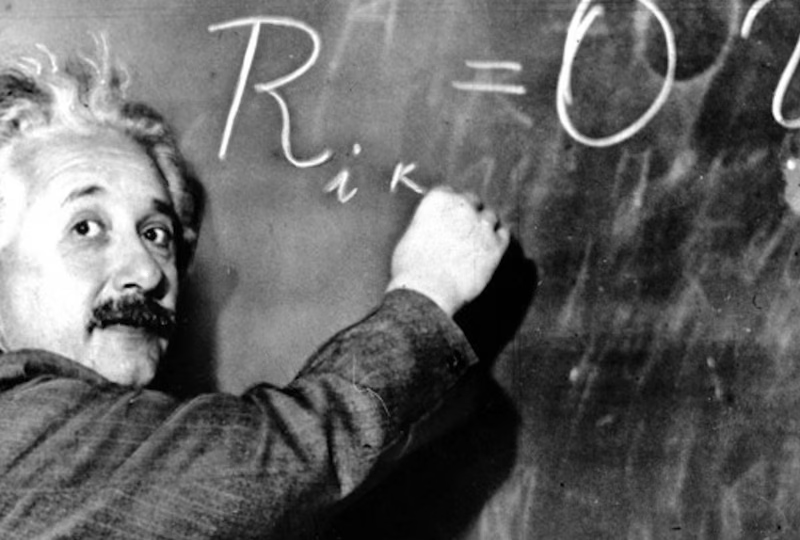
Albert Einstein. A name synonymous with genius. His theories changed how we see the universe.
His Role: Einstein was a theoretical physicist. Born in 1879 in Germany, he became one of the most influential scientists of the 20th century.
Theory of Relativity: His most famous work, the Theory of Relativity, includes the Special and General theories. The equation E=mc², which shows the relationship between energy and mass, comes from his work on Special Relativity. This changed our understanding of time, space, and energy.
General Relativity: This theory introduced the concept of spacetime and explained gravity not as a force, but as a curvature of spacetime caused by mass. It predicted phenomena like black holes and gravitational waves, which have been confirmed by later research.
Quantum Mechanics: Einstein also contributed to the development of quantum mechanics. His work on the photoelectric effect, for which he won the Nobel Prize in 1921, showed that light can behave as both a wave and a particle. This was crucial for the development of quantum theory.
Impact on Science: Einstein’s work laid the foundation for much of modern physics. His ideas influenced everything from nuclear energy to GPS technology. He also inspired generations of scientists to explore and understand the universe.
Legacy: Einstein’s influence extends beyond physics. He was a vocal advocate for civil rights and pacifism, especially in his later years. His name has become a symbol of intelligence and curiosity.
Albert Einstein didn’t just change science; he changed how we understand reality. His theories opened new doors to understanding the universe. Next, let’s discuss Marie Curie and her groundbreaking work in radioactivity.
Marie Curie: Pioneer of Radioactivity
Marie Curie. A name synonymous with groundbreaking science. She made incredible discoveries in radioactivity.
Her Role: Marie Curie was a physicist and chemist. Born in 1867 in Poland, she moved to France for her education. Her work changed the face of science.
Discovering Radioactivity: Curie coined the term “radioactivity.” She discovered two radioactive elements: polonium and radium. Her research showed that atoms could break down and release energy.
Nobel Prizes: Curie won two Nobel Prizes. The first was in Physics in 1903, shared with her husband Pierre Curie and Henri Becquerel, for their work on radioactivity. The second was in Chemistry in 1911, for her discoveries of polonium and radium. She was the first person to win Nobel Prizes in two different scientific fields.
Impact on Medicine: Her discoveries had a huge impact on medicine. Radium was used to treat cancer, leading to the development of radiotherapy. Her work laid the foundation for modern medical imaging techniques, like X-rays.
Legacy: Marie Curie faced many challenges as a woman in science but never gave up. She opened doors for future generations of female scientists. Her work continues to influence physics, chemistry, and medicine.
Marie Curie wasn’t just a scientist; she was a trailblazer. Her discoveries revolutionized science and medicine. Next, let’s move on to Political Leaders, starting with Mahatma Gandhi.
Political Leaders
Mahatma Gandhi: Champion of Non-Violent Resistance
Mahatma Gandhi. A name that stands for peace and freedom. His non-violent resistance changed the world.
His Role: Gandhi was a leader in the Indian independence movement. Born in 1869, he fought against British colonial rule using non-violent methods.
Non-Violent Resistance: Gandhi’s approach was simple but powerful. He believed in “Satyagraha” – the power of truth and non-violence. Protests, marches, and boycotts were his tools. He inspired millions to stand up for their rights without using violence.
Salt March: One of his most famous acts was the Salt March in 1930. Gandhi walked 240 miles to the Arabian Sea to make salt, protesting British salt taxes. This act of civil disobedience drew global attention to the Indian independence movement.
Impact on India: Gandhi’s efforts led to India gaining independence from Britain in 1947. His teachings on non-violence influenced many future leaders and movements worldwide.
Legacy: Gandhi’s philosophy of non-violence has inspired countless movements for civil rights and freedom. Leaders like Martin Luther King Jr. and Nelson Mandela drew from his ideas. His message of peace and justice remains relevant today.
Mahatma Gandhi wasn’t just a leader; he was a symbol of peace and resistance. His non-violent methods changed the course of history. Next, let’s look at Abraham Lincoln and his leadership during the American Civil War.
Abraham Lincoln: Preserver of the Union

Abraham Lincoln. One of America’s greatest presidents. His leadership during the Civil War kept the United States together.
His Role: Lincoln was the 16th President of the United States, serving from 1861 to 1865. Born in a log cabin in 1809, he rose from humble beginnings to the highest office in the land.
Civil War Leadership: Lincoln led the country through the Civil War, the most challenging period in American history. His primary goal was to preserve the Union. He faced enormous pressure but remained steadfast.
Emancipation Proclamation: In 1863, Lincoln issued the Emancipation Proclamation, which declared that all slaves in Confederate states were to be set free. This was a bold move that changed the war’s focus to include the fight against slavery.
Gettysburg Address: One of his most famous speeches, delivered in 1863, the Gettysburg Address, redefined the purpose of the war. It emphasized liberty, equality, and democracy, reminding Americans of the nation’s founding principles.
Assassination: Lincoln was assassinated in April 1865, just days after the Civil War ended. His death was a great loss for the nation, but his legacy endured.
Legacy: Lincoln is remembered for his dedication to the Union and his role in ending slavery. He is often regarded as one of the greatest U.S. presidents, and his leadership principles continue to inspire.
Abraham Lincoln wasn’t just a president; he was a symbol of perseverance and justice. His leadership helped shape the nation. Next, let’s explore Nelson Mandela and his fight against apartheid.
Nelson Mandela: The Fight Against Apartheid
Nelson Mandela. A name that stands for freedom and justice. His struggle against apartheid changed South Africa and inspired the world.
His Role: Mandela was a South African anti-apartheid revolutionary and political leader. Born in 1918, he dedicated his life to ending racial segregation and oppression.
Anti-Apartheid Activism: Mandela joined the African National Congress (ANC) in 1944. He became a key figure in the fight against apartheid, a system of institutionalized racial segregation and discrimination in South Africa.
Imprisonment: In 1962, Mandela was arrested and sentenced to life in prison for his anti-apartheid activities. He spent 27 years behind bars, becoming a global symbol of resistance and resilience.
Release and Presidency: Mandela was released in 1990. Four years later, in 1994, he became South Africa’s first black president after the country’s first multiracial elections. His presidency marked the end of apartheid and the beginning of a new era of reconciliation and nation-building.
Truth and Reconciliation Commission: To heal the nation, Mandela established the Truth and Reconciliation Commission, which aimed to uncover the truth about human rights abuses during apartheid and promote forgiveness and unity.
Legacy: Mandela’s influence extends far beyond South Africa. He is celebrated worldwide for his commitment to peace, justice, and equality. His life and work continue to inspire movements for freedom and human rights.
Nelson Mandela wasn’t just a leader; he was a beacon of hope and courage. His fight against apartheid changed the course of history. Next, we’ll discuss Cultural Icons, starting with William Shakespeare.
Cultural Icons
William Shakespeare: The Bard of Avon
William Shakespeare. A name that defines literature. His works have shaped the English language and world literature.
His Role: Shakespeare was an English playwright, poet, and actor. Born in 1564 in Stratford-upon-Avon, he is often called England’s national poet and the “Bard of Avon.”
Plays and Poems: He wrote 39 plays, 154 sonnets, and two long narrative poems. His plays include tragedies like “Hamlet” and “Macbeth,” comedies like “A Midsummer Night’s Dream,” and histories like “Henry V.”
Impact on Language: Shakespeare’s influence on the English language is immense. He coined many words and phrases still in use today. His work enriched the language, adding depth and expression.
Timeless Themes: His plays explore universal themes like love, power, jealousy, betrayal, and the human condition. These themes make his work timeless and relevant across centuries.
Cultural Impact: Shakespeare’s work has been translated into every major language and performed more often than any other playwright. His influence extends to literature, theater, and beyond.
Legacy: Shakespeare’s impact on culture is unparalleled. His works are studied in schools around the world and continue to inspire writers, actors, and artists. His legacy lives on through countless adaptations and interpretations.
William Shakespeare wasn’t just a playwright; he was a master of words and a keen observer of human nature. His works continue to captivate and inspire. Next, let’s delve into Leonardo da Vinci and his contributions to art, science, and innovation.
Leonardo da Vinci: The Renaissance Genius
Leonardo da Vinci. A name that stands for genius. He was an artist, scientist, and inventor who left a lasting legacy.
His Role: Leonardo was born in 1452 in Italy. He epitomized the Renaissance humanist ideal, excelling in multiple fields and making groundbreaking contributions.
Art: Leonardo’s art is legendary. His masterpieces include “The Last Supper” and “Mona Lisa.” These works are known for their intricate details, emotional depth, and innovative techniques.
Science and Engineering: Leonardo was a pioneer in anatomy, engineering, and physics. He studied the human body meticulously, creating detailed anatomical drawings. His sketches of machines, like flying devices and armored vehicles, were ahead of his time.
Inventions: Though many of his inventions were not built in his lifetime, his ideas were revolutionary. He conceptualized helicopters, tanks, and various tools that inspired future innovations.
Notebooks: Leonardo’s notebooks are a treasure trove of knowledge. They contain sketches, scientific diagrams, and reflections on art and science. These notebooks provide insight into his thought processes and genius.
Legacy: Leonardo da Vinci’s influence spans art, science, and technology. He embodied the spirit of curiosity and creativity. His work continues to inspire and educate across disciplines.
Leonardo da Vinci wasn’t just a master artist; he was a visionary thinker. His contributions shaped the Renaissance and continue to impact our world today. Next, let’s explore Martin Luther King Jr. and his role in the Civil Rights Movement.
Martin Luther King Jr.: Leader of the Civil Rights Movement

Martin Luther King Jr. A name synonymous with civil rights and equality. His leadership transformed the fight for racial justice in America.
His Role: Born in 1929, King was a Baptist minister and activist who became the most visible leader of the Civil Rights Movement. He advocated for non-violent resistance to racial segregation and injustice.
I Have a Dream: King’s most famous speech, “I Have a Dream,” delivered in 1963 during the March on Washington, is a defining moment in American history. He spoke of his vision for a future where people would be judged by their character, not the color of their skin.
Non-Violent Protests: Inspired by Mahatma Gandhi, King led numerous non-violent protests, including the Montgomery Bus Boycott and the Birmingham Campaign. These actions brought national attention to the struggle for civil rights.
Civil Rights Legislation: King’s efforts were instrumental in the passage of landmark civil rights legislation. The Civil Rights Act of 1964 and the Voting Rights Act of 1965 were significant victories in the fight against racial discrimination.
Nobel Peace Prize: In 1964, King was awarded the Nobel Peace Prize for his efforts to combat racial inequality through non-violent means. His recognition brought global attention to the Civil Rights Movement.
Legacy: Martin Luther King Jr.’s impact is profound. His principles of equality, justice, and non-violence continue to inspire movements worldwide. He is honored annually on Martin Luther King Jr. Day, a U.S. federal holiday.
Martin Luther King Jr. wasn’t just a leader; he was a beacon of hope and justice. His dream of equality continues to inspire and guide us.
Conclusion
Throughout history, certain individuals have left an indelible mark on the world.
Figures like Julius Caesar, Confucius, Alexander the Great, Jesus Christ, Prophet Muhammad, Buddha, Isaac Newton, Albert Einstein, Marie Curie, Mahatma Gandhi, Abraham Lincoln, Nelson Mandela, William Shakespeare, Leonardo da Vinci, and Martin Luther King Jr. shaped the course of human civilization.
Their contributions, from military conquests to philosophical teachings, scientific discoveries, political reforms, and cultural advancements, continue to influence our lives today.
These influential figures remind us of the power of human potential. Their legacies teach us about leadership, perseverance, and the impact one person can have on the world. Reflecting on their achievements, we gain inspiration to make our own positive mark on history.
Related Content:
Ancient Civilizations Timeline: A Beginner’s Overview
Silk Road Marketplace: The $1.2b e-Commerce Darkweb Site
Commonly Asked Questions
Determining the single most influential person in history is subjective and depends on the criteria used. However, many historians and scholars often cite Jesus Christ as the most influential figure due to his profound impact on religion, culture, and history. His teachings and life have shaped Christianity, which has billions of followers and has significantly influenced Western civilization and beyond.
Power can be defined in many ways, including political influence, military might, and cultural impact. Here are a few figures often considered among the most powerful in history:
- Genghis Khan: Founder of the Mongol Empire, which became the largest contiguous empire in history. His military conquests reshaped the map of Asia and Europe.
- Alexander the Great: His conquests created one of the largest empires of the ancient world and spread Greek culture across three continents.
- Julius Caesar: His role in the rise of the Roman Empire and his influence on Roman politics and military are monumental.
- Napoleon Bonaparte: His military and political leadership redefined France and had a lasting impact on European and global history.
- Mahatma Gandhi: Though he wielded no traditional political or military power, his influence on the Indian independence movement and non-violent resistance strategies had a profound global impact.
The title of the most famous man in history can also be subjective and vary based on cultural and regional perspectives. However, some figures are universally recognized:
- Jesus Christ: Due to his central role in Christianity, he is known and revered worldwide.
- Albert Einstein: Known for his contributions to physics and his iconic status as a symbol of genius.
- Mahatma Gandhi: Known globally for his leadership in the Indian independence movement and his philosophy of non-violence.
- Nelson Mandela: Recognized worldwide for his fight against apartheid and his leadership in South Africa.
Each of these individuals has left an indelible mark on history and continues to be widely recognized across the globe.



Leave a Reply