
Introduction
Buddha: The Enlightened One. His teachings have inspired millions and shaped entire cultures. Born as Siddhartha Gautama, he left a life of luxury in search of deeper truths. His journey led him to enlightenment and laid the foundation for Buddhism, a religion and philosophy followed by millions today.
Imagine a prince giving up his palace to find the meaning of life. Intrigued? Buddha’s story is one of adventure, wisdom, and profound change. Let’s explore how his path to enlightenment and his teachings continue to influence the world.
Table of Contents
Early Life

Birth as Siddhartha Gautama
Siddhartha Gautama, who would later be known as Buddha, was born around 563 BCE in Lumbini, in what is now modern-day Nepal. He was born into a royal family, the son of King Suddhodana and Queen Maya. His birth was accompanied by several miraculous signs, indicating his future greatness.
Early Years and Family Background
Siddhartha grew up in the lap of luxury. His father, King Suddhodana, ensured that he was shielded from the harsh realities of life, surrounding him with every comfort and pleasure. The young prince was provided with the finest education and trained in the arts of war and governance.
Despite his privileged upbringing, Siddhartha was naturally introspective and compassionate. He married Yasodhara, a beautiful princess, and they had a son named Rahula. However, Siddhartha felt a growing sense of dissatisfaction with his sheltered life. This inner turmoil set the stage for his transformative journey, as he began to question the nature of existence and the true path to happiness.
Path to Enlightenment

Renunciation of Princely Life
At the age of 29, Siddhartha Gautama experienced a profound awakening.
Despite his royal privileges, he was troubled by the suffering he saw around him.
His encounters with an old man, a sick man, a dead body, and a wandering ascetic revealed the inevitable truths of aging, illness, death, and the quest for deeper meaning. These sights deeply affected him, compelling Siddhartha to seek a solution to the suffering of all beings.
One night, he left his palace, family, and luxurious life behind. Donning simple robes and cutting off his hair, he embraced the life of a wandering ascetic.
Search for Spiritual Knowledge
Siddhartha spent the next six years in rigorous spiritual practices. He studied under various teachers, mastering their teachings but finding them insufficient for true enlightenment. He practiced severe austerities, including prolonged fasting and intense meditation, pushing his body to its limits.
Despite his dedication, these extreme measures did not bring him the answers he sought.
Realizing that neither indulgence nor self-mortification could lead to enlightenment, Siddhartha adopted the Middle Way—a path of balance between extremes.
Attainment of Enlightenment under the Bodhi Tree
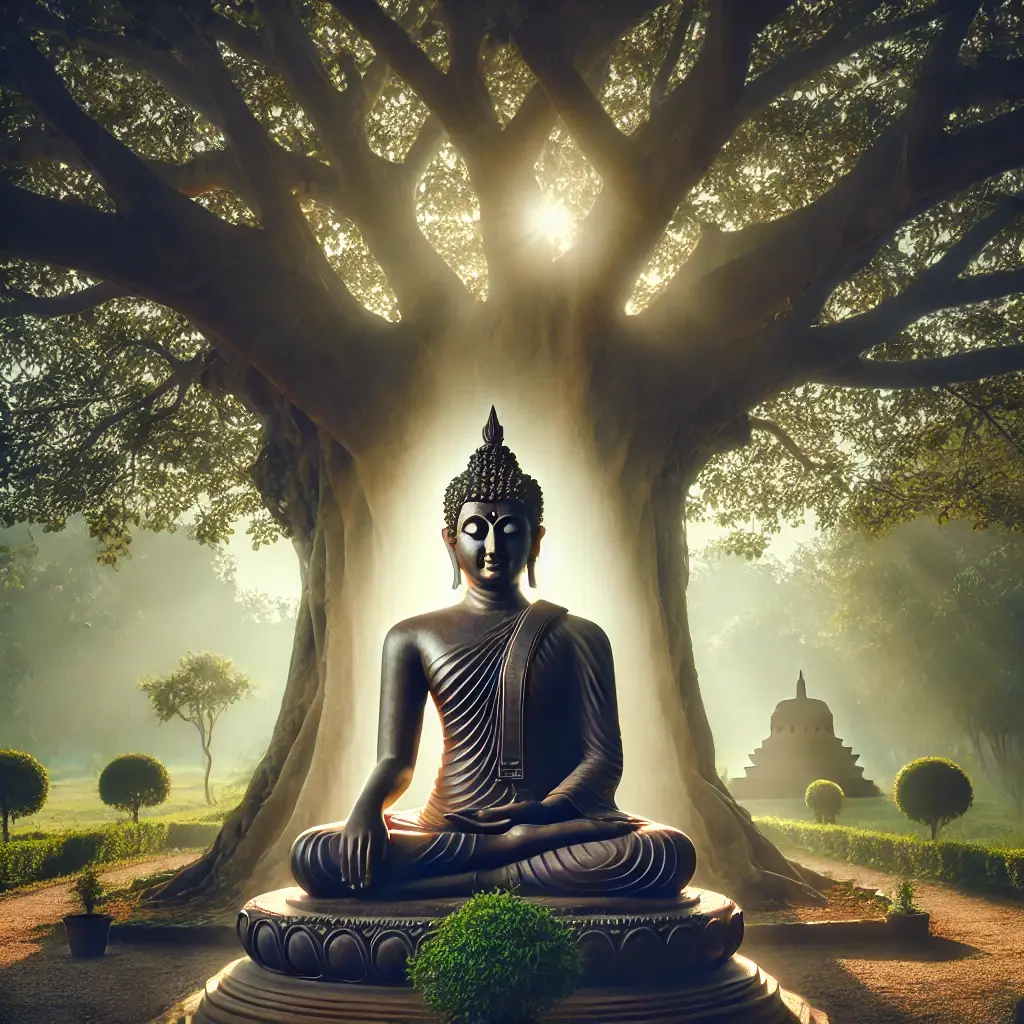
At the age of 35, Siddhartha sat beneath the Bodhi tree in Bodh Gaya, vowing not to rise until he had attained enlightenment.
He entered deep meditation, confronting and overcoming the temptations and distractions of Mara, the evil one. After a night of profound insight and realization, Siddhartha achieved enlightenment as the dawn broke. He became the Buddha, the Awakened One.
Under the Bodhi tree, he understood the nature of suffering, its causes, and the path to its cessation, which he later articulated as the Four Noble Truths and the Eightfold Path.
This moment marked the culmination of his search and the beginning of his mission to teach others the way to enlightenment.
Teachings and Principles

The Four Noble Truths
Buddha’s teachings began with the Four Noble Truths, which form the foundation of Buddhist philosophy:
- The Truth of Suffering (Dukkha): Life is filled with suffering, which includes not only physical pain but also emotional and mental distress.
- The Truth of the Cause of Suffering (Samudaya): Suffering is caused by desire and attachment. Our cravings for pleasure, material goods, and eternal life lead to discontent.
- The Truth of the End of Suffering (Nirodha): Suffering can be overcome and happiness attained. This cessation of suffering is known as Nirvana, a state of liberation and freedom from attachment.
- The Truth of the Path Leading to the End of Suffering (Magga): There is a path to end suffering, which is the Noble Eightfold Path.
The Eightfold Path
The Noble Eightfold Path is Buddha’s guide to end suffering and achieve enlightenment. It is divided into three categories: wisdom, ethical conduct, and mental discipline.
- Right Understanding: Comprehending the Four Noble Truths.
- Right Intention: Cultivating an attitude of compassion and renunciation.
- Right Speech: Speaking truthfully, avoiding slander, gossip, and harmful language.
- Right Action: Acting ethically, avoiding actions that cause harm, such as killing, stealing, and sexual misconduct.
- Right Livelihood: Earning a living in a way that does not cause harm to others.
- Right Effort: Cultivating positive states of mind and eliminating negative ones.
- Right Mindfulness: Developing awareness of the body, feelings, mind, and phenomena.
- Right Concentration: Practicing meditation to achieve a state of mental focus and tranquility.
Key Teachings and Their Impact on Followers
Buddha’s teachings emphasize the importance of self-awareness, ethical behavior, and mental discipline. He taught that enlightenment is attainable by anyone who follows the path with dedication and sincerity. Key teachings include:
- Impermanence (Anicca): Everything is transient and subject to change.
- Non-Self (Anatta): There is no permanent, unchanging self or soul.
- Compassion (Karuna): Extending kindness and compassion to all beings.
These teachings had a profound impact on his followers, providing a practical framework for overcoming suffering and leading a meaningful life. The establishment of the Sangha, a community of monks and nuns, helped preserve and disseminate his teachings. Over time, Buddhism spread across Asia, influencing cultures, philosophies, and spiritual practices worldwide. Buddha’s emphasis on compassion, mindfulness, and ethical living continues to inspire and guide millions of people today.
Challenges and Triumphs
Opposition and Support During His Lifetime
Buddha faced both opposition and support throughout his life. Initially, his teachings were met with resistance from the established religious and social order. Brahmins, who held significant religious authority, viewed his teachings as a threat to their traditional practices and caste-based society. Despite this, Buddha gained support from many, including influential kings and wealthy patrons who were moved by his wisdom and compassion. Ordinary people also found hope and solace in his message, which emphasized personal responsibility and ethical living.
Spreading His Teachings
Buddha’s approach to spreading his teachings was practical and inclusive. He traveled extensively across the Indian subcontinent, teaching in villages, towns, and cities. His method was simple: he spoke in the local languages and used everyday examples to explain profound concepts. This accessibility helped his teachings reach a wide audience. He also adapted his message to suit different listeners, making Buddhism appealing to people from various walks of life. Over time, his teachings attracted a diverse group of followers, including kings, merchants, farmers, and even former adversaries.
Establishment of the Sangha (Community of Monks)
One of Buddha’s most significant achievements was the establishment of the Sangha, a community of monks and nuns dedicated to practicing and preserving his teachings. The Sangha provided a structured environment for spiritual growth and offered an alternative to the conventional life of householders. Members of the Sangha followed a disciplined lifestyle, adhering to ethical precepts and engaging in meditation and study.
The establishment of the Sangha played a crucial role in the spread and longevity of Buddhism. Monks and nuns traveled widely, sharing Buddha’s teachings and establishing monastic communities across India and beyond. These communities became centers of learning and spiritual practice, attracting students and devotees from far and wide. The Sangha also served as a support network, ensuring that Buddha’s teachings were faithfully transmitted through generations.
The combination of Buddha’s personal charisma, the support of his followers, and the institutional foundation of the Sangha allowed Buddhism to flourish and expand. Despite challenges, Buddha’s teachings endured and spread across Asia, laying the groundwork for one of the world’s major religions.
Impact and Legacy

Influence on Buddhism
Buddha’s teachings form the core of Buddhism, which has grown into a major world religion. His insights into the nature of suffering and the path to enlightenment are central to Buddhist practice and philosophy. The concepts of the Four Noble Truths and the Eightfold Path provide a comprehensive framework for ethical conduct, mental discipline, and spiritual development. The establishment of the Sangha ensured that these teachings were preserved and transmitted through generations, maintaining the integrity of Buddha’s message.
Broader Cultural and Historical Impact
Buddha’s influence extends beyond the realm of religion. His teachings have significantly shaped Asian cultures, including art, literature, philosophy, and social values. The principles of compassion, non-violence, and mindfulness have permeated various aspects of life in countries where Buddhism took root. Monastic institutions became centers of learning, contributing to advancements in education, medicine, and the arts. The spread of Buddhism facilitated cultural exchange and dialogue between different regions, fostering a spirit of tolerance and understanding.
Buddha’s emphasis on non-attachment and the impermanence of all things challenged prevailing social norms and offered an alternative worldview that valued inner peace over material success. His ideas influenced other religious traditions, including Hinduism, Jainism, and later, even Western thought through the encounters between East and West.
Lasting Legacy in Modern Times
Buddha’s legacy continues to thrive in the modern world. Buddhism remains a major spiritual tradition, with millions of followers globally. His teachings on mindfulness and meditation have found a place in contemporary psychology and wellness practices, contributing to mental health and personal well-being. Concepts like mindfulness, once confined to Buddhist practice, are now widely adopted in stress reduction programs, corporate training, and education.
Moreover, Buddha’s message of compassion and ethical living resonates strongly in today’s global society, addressing contemporary issues such as environmental sustainability, social justice, and intercultural dialogue. Buddhist leaders and practitioners play active roles in promoting peace, human rights, and ecological awareness.
In popular culture, the figure of Buddha symbolizes peace, wisdom, and enlightenment. His life story and teachings inspire books, films, and art, keeping his legacy alive in diverse and dynamic ways. The continued relevance of Buddha’s teachings in addressing the challenges of modern life underscores the enduring impact of his profound insights and compassionate vision.
Conclusion
Buddha, the Enlightened One, left an indelible mark on history and humanity. His teachings on the nature of suffering, the path to enlightenment, and the principles of compassion and mindfulness have shaped the lives of millions and influenced entire cultures. From the moment he attained enlightenment under the Bodhi tree, his message has been one of hope, ethical living, and spiritual awakening.
Reflecting on Buddha’s journey and teachings, we see a timeless relevance that speaks to the human condition. In today’s fast-paced and often stressful world, his principles of mindfulness and compassion offer a pathway to inner peace and societal harmony.
Consider how you can apply Buddha’s wisdom in your own life. Embrace the practice of mindfulness, cultivate compassion for others, and strive for ethical living. Let his teachings inspire you to seek balance, understanding, and peace in every aspect of your life. How will you embark on your own path to enlightenment?
Related Content:
Confucius: The Sage Who Shaped Eastern Philosophy
Most Influential People in History
Ancient Civilizations Timeline: A Beginner’s Overview
Commonly Asked Questions
Buddha is neither considered a god nor a lord in the traditional sense. In Buddhism, Siddhartha Gautama, known as the Buddha, is revered as an enlightened teacher who attained profound wisdom and insight into the nature of existence. He is respected and honored for his teachings, but he is not worshipped as a deity. Instead, he is seen as a guide who showed the way to enlightenment.
Buddha is known for his teachings on the nature of suffering and the path to overcome it. His key contributions include the Four Noble Truths and the Eightfold Path, which provide a practical framework for ethical living, mental discipline, and spiritual development. He is also known for founding the Sangha, the community of monks and nuns, and for promoting principles such as compassion, non-violence, and mindfulness. His insights have had a profound influence on religion, philosophy, and culture worldwide.
Buddha, born as Siddhartha Gautama, was Indian. He was born in Lumbini, which is in present-day Nepal, but during his time, it was part of ancient India. His teachings originated in India and spread to other parts of Asia, including China, where Buddhism later became a major religious and cultural force.



Leave a Reply