
Introduction
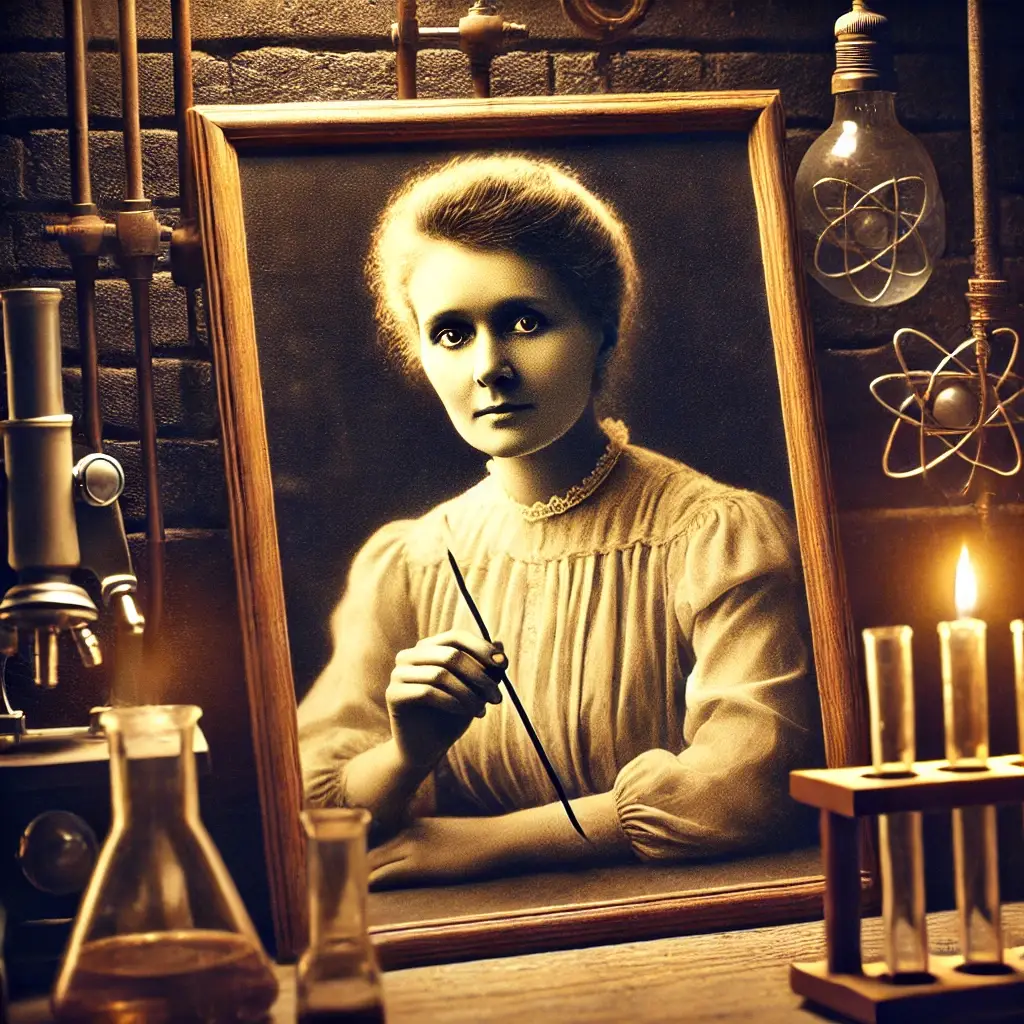
Marie Curie. A name that changed the world of science. She wasn’t just a scientist; she was a trailblazer, a woman who broke barriers in a male-dominated field.
Born in 1867, Curie’s work on radioactivity revolutionized physics and chemistry. She discovered elements, won two Nobel Prizes, and paved the way for future generations of scientists.
But her story isn’t just about science—it’s about determination, grit, and breaking down walls. Ready to dive into the life of one of the most influential figures in history?
Let’s explore the extraordinary journey of Marie Curie.
Table of Contents
Early Life
Birth and Childhood
Marie Curie was born Maria Sklodowska on November 7, 1867, in Warsaw, Poland. She grew up in a family that valued education, with both parents working as teachers. Despite the political struggles in Poland at the time, Curie was a bright and curious child, showing an early interest in learning, especially in science and math.
However, life wasn’t easy for young Marie. Her family faced financial difficulties, and the Russian authorities who controlled Poland imposed strict restrictions on education. But Marie’s passion for knowledge couldn’t be stifled. She excelled in her studies, often reading books late into the night, determined to learn as much as she could.
Education and Early Scientific Interests
In a time when higher education for women was almost unheard of, Marie was determined to pursue her academic dreams. After finishing high school, she couldn’t attend university in Poland because women were not allowed. Instead, she joined the “Flying University,” a secret institution that provided higher education to women.
To further her education, Marie worked as a governess to save money and support her sister’s medical studies in Paris, with the understanding that her sister would later help her do the same. During these years, she continued to study independently, feeding her growing passion for physics and chemistry.
Marie’s early life was marked by determination and a relentless pursuit of knowledge, despite the many obstacles she faced. This drive would eventually lead her to Paris, where her life—and the world—would change forever.
Journey to Paris and Early Research

Move to Paris and Study at the Sorbonne
In 1891, at the age of 24, Marie moved to Paris to attend the University of Paris, better known as the Sorbonne. This was a bold move—Paris was the epicenter of science, and Marie was stepping into a world far different from the one she knew in Poland. She enrolled in physics and mathematics, throwing herself into her studies with the same determination she had shown back home.
Life in Paris wasn’t easy. Marie lived in a small, unheated attic and often went without food to make ends meet. But the hardships didn’t deter her. She quickly distinguished herself as one of the brightest students at the Sorbonne, graduating at the top of her class in physics in 1893, and earning a second degree in mathematics a year later.
Meeting Pierre Curie and Early Research in Radioactivity
While pursuing her studies, Marie needed a lab space to conduct her experiments. This led her to meet Pierre Curie, a brilliant physicist who was already well-respected in the scientific community. They shared a deep passion for science, and it wasn’t long before they fell in love. The two were married in 1895, and Marie took on the name Marie Curie.
Together, the Curies formed a powerful scientific partnership. Marie became fascinated with Henri Becquerel’s discovery of mysterious rays emitted by uranium, which later became known as radioactivity. With Pierre’s support and collaboration, Marie began her groundbreaking research into this phenomenon.
Marie Curie’s move to Paris marked the beginning of her journey into the heart of scientific discovery. Her early research, driven by curiosity and an unyielding work ethic, set the stage for the incredible breakthroughs that were yet to come.
Discoveries and Major Works

Discovery of Polonium and Radium
Marie Curie’s research into radioactivity led to one of the most significant scientific discoveries of the 20th century. She hypothesized that the mysterious rays were not just a property of uranium but a fundamental characteristic of certain atoms. With this idea in mind, she began meticulously experimenting with various minerals.
In 1898, after countless hours in the lab, Marie and Pierre Curie discovered a new element, which they named polonium, after Marie’s native Poland. But they didn’t stop there. Later that same year, they isolated another new element—radium. This element, far more radioactive than uranium, would become central to their research.
Isolating these elements was no easy task. The Curies worked in a makeshift lab, often in difficult conditions, processing tons of ore to extract just a tiny amount of radium. Despite the physical toll this work took on them, their dedication never wavered.
Groundbreaking Research in Radioactivity
Marie Curie’s discoveries didn’t just add new elements to the periodic table; they fundamentally changed our understanding of matter and energy. She coined the term “radioactivity” to describe the emission of rays from certain elements, and her work laid the groundwork for the development of atomic physics.
In 1903, Marie Curie made history by becoming the first woman to win a Nobel Prize, sharing the Nobel Prize in Physics with Pierre Curie and Henri Becquerel for their work on radioactivity. But she wasn’t finished yet. In 1911, she won a second Nobel Prize, this time in Chemistry, for her discovery of radium and polonium, making her the first person ever to win Nobel Prizes in two different scientific fields.
Winning the Nobel Prizes
Marie’s achievements were groundbreaking, but they didn’t come without challenges. She faced skepticism and prejudice from the male-dominated scientific community, yet her work was impossible to ignore. The Nobel Prizes she received were not just a recognition of her brilliance but also a validation of her perseverance and dedication to science.
Marie Curie’s discoveries and research revolutionized science. Her work on radioactivity opened the door to new fields of study and had profound implications for medicine, particularly in the treatment of cancer. Her legacy as a scientist and a pioneer is etched into the very fabric of modern science.
Later Life and Legacy

Contributions During World War I
When World War I broke out in 1914, Marie Curie didn’t hesitate to put her scientific knowledge to practical use. Recognizing the need for better medical care on the battlefield, she developed mobile radiography units, later known as “Little Curies.” These mobile X-ray units allowed doctors to take X-rays of wounded soldiers on the front lines, greatly improving the accuracy of medical treatment.
Curie personally oversaw the installation of these units and even drove one herself to the battlefront. She trained other women to operate the machines, effectively creating a new field of wartime medical technology. Her efforts saved countless lives, and her work during the war cemented her legacy as a scientist who used her knowledge to help humanity in times of crisis.
Establishment of the Curie Institutes
After the war, Marie Curie focused on furthering her research and establishing institutions that would carry on her work. In 1914, she founded the Radium Institute in Paris, which became a leading center for research in radioactivity. This institute, later named the Curie Institute, remains one of the world’s foremost research centers in the fields of physics, chemistry, and medicine.
In addition to the Paris institute, Curie also helped establish a similar institute in Warsaw, Poland, in 1932. Both institutions were dedicated to advancing research in radioactivity and training the next generation of scientists. These institutes continue to contribute to groundbreaking research, particularly in the treatment of cancer, demonstrating the lasting impact of Curie’s work.
Final Years and Death
Marie Curie’s intense work with radioactive materials took a toll on her health. By the 1920s, she was suffering from symptoms of what was likely radiation poisoning, although the dangers of prolonged exposure to radioactivity were not fully understood at the time. Despite her declining health, she continued her research and work with the Curie Institutes.
Marie Curie passed away on July 4, 1934, from aplastic anemia, a condition believed to have been caused by her long-term exposure to radiation. She was laid to rest beside her husband, Pierre, in Sceaux, France. In 1995, in recognition of her immense contributions to science, her remains were moved to the Panthéon in Paris, making her the first woman to be honored with such a burial on her own merits.
Marie Curie’s later years were marked by both incredible achievements and personal sacrifice. Her dedication to science, even at great personal cost, and her commitment to using her knowledge for the betterment of humanity have left a legacy that continues to inspire.
Legacy

Impact on Science and Medicine
Marie Curie’s work laid the foundation for modern physics and chemistry, particularly in the study of radioactivity. Her discoveries of polonium and radium opened new avenues in scientific research and led to the development of nuclear energy. But perhaps her most significant contribution was to medicine. The use of radium in cancer treatment revolutionized oncology, leading to the development of radiation therapy, which is still a cornerstone of cancer treatment today.
Curie’s meticulous research methods and her ability to overcome the limitations of her time set new standards in scientific inquiry. She didn’t just contribute to the advancement of knowledge; she also changed how science was practiced, emphasizing the importance of thorough, hands-on experimentation.
Breaking Barriers as a Woman in Science
Marie Curie was not just a pioneer in her field; she was a trailblazer for women in science. At a time when women were often excluded from higher education and scientific research, Curie’s achievements shattered gender barriers. She was the first woman to win a Nobel Prize, the first person to win two Nobel Prizes in different scientific fields, and the first woman to teach at the Sorbonne.
Curie’s success proved that women could excel in the highest levels of science, inspiring generations of women to pursue careers in fields previously dominated by men. Her perseverance in the face of discrimination and her ability to balance her roles as a scientist, wife, and mother make her a role model not just for women, but for anyone facing obstacles in their path.
Lasting Influence on Future Generations
Marie Curie’s legacy extends far beyond her lifetime. The Curie Institutes in Paris and Warsaw continue to be leading research centers, carrying on her work in radioactivity and cancer treatment. Her life and achievements have been celebrated in numerous books, films, and documentaries, making her one of the most well-known scientists in history.
Curie’s story is a powerful reminder of what can be achieved through dedication, hard work, and a refusal to be limited by societal expectations. Her impact on science, medicine, and gender equality continues to resonate today, proving that her legacy is as enduring as the elements she discovered.
Marie Curie didn’t just change the world with her discoveries—she changed the world with her example. Her life’s work has saved countless lives, inspired millions, and will continue to influence the world for generations to come.
Conclusion
Marie Curie was more than just a scientist—she was a pioneer, a trailblazer, and a symbol of perseverance. Her discoveries in radioactivity not only revolutionized science and medicine but also shattered barriers for women in fields dominated by men. She faced immense challenges, from financial struggles to health issues caused by her research, yet she never wavered in her pursuit of knowledge.
Curie’s legacy is a testament to the power of determination and curiosity. She showed the world that with passion and hard work, even the most impossible goals can be achieved. Her story continues to inspire, reminding us that science is not just about discovery—it’s about making a lasting impact on the world.
So, what can we learn from Marie Curie? Whether you’re facing challenges in your career, education, or personal life, remember her story. Keep pushing forward, stay curious, and don’t let obstacles stop you from reaching your full potential. Like Curie, you too can make a difference.
Related Content:
Isaac Newton: The Father of Modern Physics
Albert Einstein: The Genius Who Changed Our Universe
Most Influential People in History
Commonly Asked Questions
Marie Curie was 66 years old when she died. She passed away on July 4, 1934, from aplastic anemia, a condition believed to have been caused by her prolonged exposure to radiation during her research.
Marie Curie is most known for her groundbreaking work in the field of radioactivity. She discovered the elements polonium and radium and coined the term “radioactivity” to describe the phenomenon. Curie was the first woman to win a Nobel Prize and remains the only person to have won Nobel Prizes in two different scientific fields—Physics in 1903 and Chemistry in 1911.
After the tragic death of her husband, Pierre Curie, in 1906, Marie Curie continued their work on radioactivity. She was appointed to her husband’s professorship at the University of Paris, becoming the first woman to teach there. Despite the personal and professional challenges, she advanced her research, ultimately winning her second Nobel Prize in 1911. Curie also raised their two daughters, one of whom, Irène Joliot-Curie, would go on to win a Nobel Prize herself.



Leave a Reply