
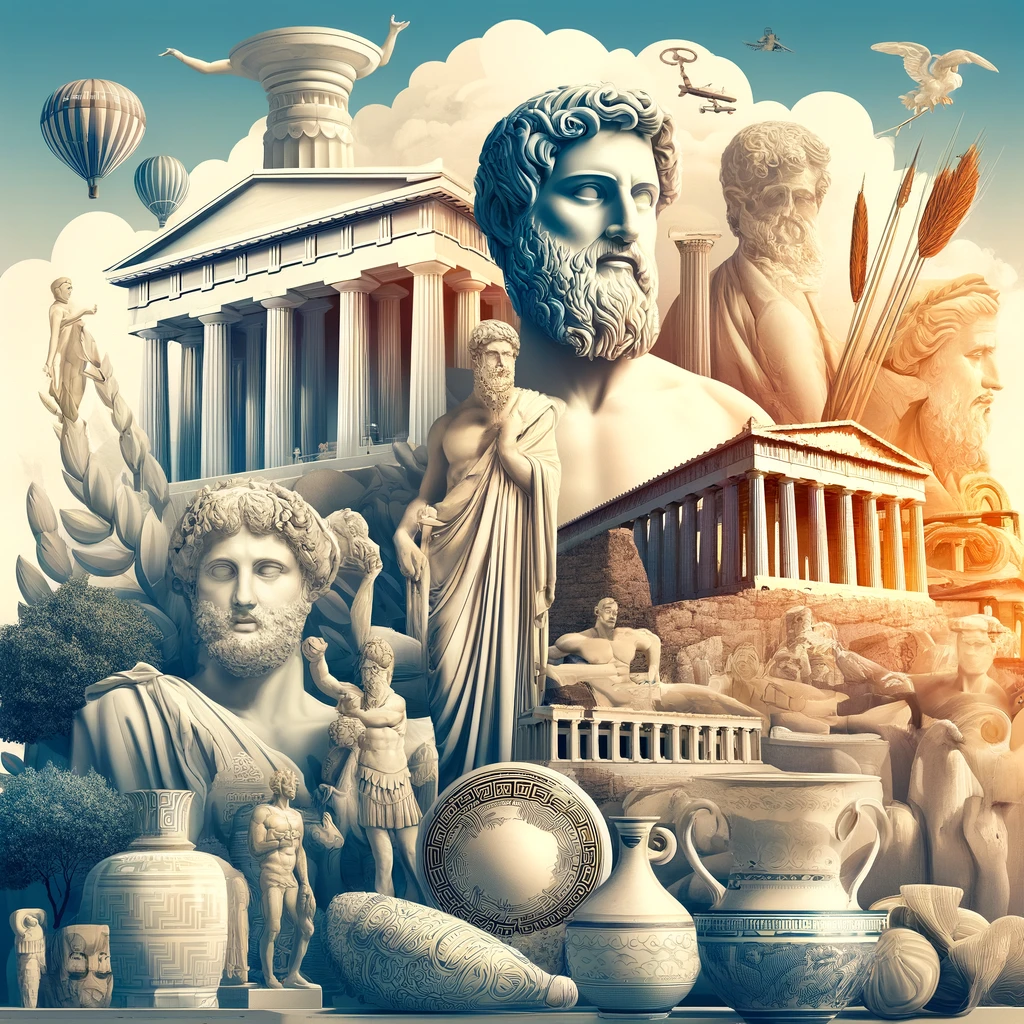
Introduction: The Legacy of Ancient Greece
Ancient Greece isn’t just a chapter in history books; it’s the cornerstone of Western civilization as we know it. This wasn’t just a place of myths and legends, but the birthplace of democracy, philosophy, the Olympics, and so much more that has shaped modern Western culture, politics, science, and art. Imagine a world without the ideas of democracy from Athens or the philosophical musings of Plato and Aristotle. Hard, right? That’s the impact of Ancient Greece.
The story of Greece unfolds over millennia, starting with the early Minoan civilization on Crete around 2000 BC, moving to the heroic age of the Mycenaean kingdoms, and then transitioning to the dark ages. But the spotlight hits with the Archaic period, where city-states like Athens and Sparta emerge. The Classical period follows, a golden age of art, thought, and political innovation, leading up to the world-shaking conquests of Alexander the Great in the Hellenistic period. This epic tale wraps up with the Roman conquest of Greece by 146 BC, but by then, Greek culture had left an indelible mark on Rome and the wider world.
Through every twist and turn, from the ancient ruins of the Acropolis to the timeless tales of Homer, the legacy of Ancient Greece continues to influence our modern lives. It’s a testament to the enduring power of Greek ideas, creativity, and spirit.
Table of Contents
- Introduction
- The Dawn of Democracy
- Philosophical Pioneers
- Mythology and Religion
- Architectural Marvels
- The Olympic Games
- Warfare and Expansion
- Art and Literature
- Conclusion
The Dawn of Democracy: Athens Leads the Way
Origins in Athens
Democracy as we know it began in Athens around the 5th century BC. Before democracy, Athens was ruled by kings, and later by a group of aristocrats.
But the people wanted a say, and they got it. The word “democracy” itself comes from the Greek words “demos” (people) and “kratos” (power), literally meaning “power of the people.” Cleisthenes, often called the “Father of Democracy,” set the ball rolling in 508 BC by reorganizing the constitution and setting up a system where every citizen had a vote in the assembly.

How It Worked
In this early form of democracy, citizens (free Athenian males over 18) had the right to participate in the assembly, which made decisions on laws, war, and foreign policy. They also had the chance to serve on juries or be elected to public office. Sure, it wasn’t perfect by modern standards—women, slaves, and foreigners were excluded—but it was a revolutionary step towards inclusive governance.
Impact on Later Systems
The Athenian model laid the groundwork for democratic systems that emerged centuries later. While direct democracy was practical for a small city-state like Athens, the principle of citizens participating in their governance inspired the representative democracies we see today. Key elements of modern democratic systems, such as legislative bodies and the concept of equality before the law, have roots in ancient Athens.
A Legacy That Endures
Athenian democracy wasn’t just a blip in history. It showed the world that a society could be organized around the participation of its citizens. Philosophers like Plato and Aristotle debated its merits and flaws, influencing political thought for generations. The Renaissance revived interest in democratic principles, and the founding fathers of the United States looked to ancient Athens as a model when drafting the Constitution.
The experiment in democracy that began in Athens has echoed through the ages, shaping the political landscape of the modern world. It stands as a testament to the idea that governance can be based on freedom, equality, and the will of the people—a legacy that continues to inspire the quest for democratic ideals around the globe.
Philosophical Pioneers: The Giants of Greek Thought
Socrates: The Questioning Mind
Socrates turned Athens into his classroom. His method? Constant questioning. He believed in seeking the truth through dialogue. Sadly, his questioning of everything got him into trouble, leading to his execution. But his legacy? Immense. He taught that an unexamined life isn’t worth living.

Plato: The World of Forms
Plato, Socrates’ student, took his teacher’s ideas further. He founded the Academy, the first institution of higher learning in the Western world. Plato’s theory of Forms suggested that the physical world isn’t really the ‘real’ world; instead, ultimate reality exists beyond our physical world. His works, especially “The Republic,” explore justice, virtue, and governance.
Aristotle: The Master of Knowledge
Aristotle, Plato’s student, was a polymath. He founded his own school, the Lyceum. Aristotle’s method involved observing the physical world and reasoning from there, which laid the groundwork for the scientific method. His contributions spanned across various fields, including biology, ethics, politics, and metaphysics.
Impact on Contemporary Thought
The ideas of these philosophers still resonate today. Socrates’ emphasis on ethical self-examination is echoed in modern debates about morality and ethics. Plato’s impact is seen in political theory, especially the idea of ideal governance. Aristotle’s work influences a range of disciplines, from logic and science to ethics and politics.
These thinkers from ancient Greece laid the foundations of Western philosophy. Their pursuit of knowledge and truth has inspired countless generations to question, understand, and explore the world around them and within them.
Mythology and Religion: The Divine Tapestry of Ancient Greece
Gods and Goddesses in Everyday Life
Greek mythology wasn’t just a collection of stories; it was the backbone of Greek culture and religion. The Greeks saw their gods in everything, from the thunderstorm that might signify Zeus’s anger to the calm seas as a blessing from Poseidon. Temples dedicated to gods and goddesses dotted the landscape, serving as places of worship and community gatherings.

The Pantheon and Its Influence
The Greek pantheon was a family affair, with Zeus at the head, ruling from Mount Olympus alongside his siblings and children. Each deity had their domain—Hera guarded marriage, Athena offered wisdom, and Dionysus brought wine and revelry. These gods and goddesses were deeply woven into the daily lives of the Greeks, influencing everything from political decisions to agricultural practices.
Heroes and Legends
Greek mythology was also full of heroes and epic adventures. Tales of Hercules and his labors, Theseus and the Minotaur, and the journey of Odysseus back to Ithaca were more than just entertainment. They conveyed moral lessons, exemplified virtues, and explained the mysteries of the natural world.
Impact on Literature and Art
The impact of Greek mythology extends far beyond antiquity. It inspired some of the greatest works of literature and art in Western history. The Iliad and the Odyssey by Homer, the tragedies of Sophocles and Euripides, and the sculptures and vases that depict mythological scenes have influenced artists and writers for centuries.
Greek mythology and religion provided a framework for understanding the world, a source of inspiration and consolation, and a way to connect the community through shared stories and rituals. Its legacy is a testament to the power of myth to shape culture, art, and collective identity.
Architectural Marvels: The Enduring Legacy of Greek Design
Foundations of Greek Architecture
Greek architecture set the standards for beauty, balance, and harmony in the Western world. Its principles and styles—Doric, Ionic, and Corinthian—have influenced architects for millennia. These styles are distinguished by their columns, with each offering a different aesthetic and level of decoration.
The Parthenon: A Symbol of Perfection
The Parthenon, dedicated to Athena, stands as a pinnacle of Greek architectural achievement. Situated on the Acropolis of Athens, it’s a masterpiece of Doric design, embodying the ideals of symmetry and proportion that define Greek architecture. Despite the ravages of time, the Parthenon remains a symbol of the artistic and cultural heights achieved by the ancient Greeks.
Theaters of Epidaurus: Harmony with Nature
Greek theaters, particularly the Theater of Epidaurus, showcase the Greeks’ skill in integrating architecture with the natural landscape. Renowned for its exceptional acoustics and aesthetic harmony, the theater of Epidaurus could seat thousands of spectators, hosting dramas that explored the human condition, a testament to the Greek belief in the power of art to influence society.
Influence on Subsequent Architectural Styles
Greek architectural principles have left a lasting mark on Western architecture. The Renaissance and Neoclassical periods, in particular, saw a revival of Greek styles, emphasizing symmetry, proportion, and the use of columns. Today, elements of Greek architecture can be seen in government buildings, museums, and memorials around the world, a tribute to the timeless appeal of Greek design.
Greek architecture is more than just a collection of buildings; it’s a philosophy made concrete, blending form, function, and beauty. Its legacy is not only in the structures that have survived but in the foundational ideas that continue to shape our built environment.
The Olympic Games: From Ancient Olympia to the World Stage
A Sacred Beginning
The Olympic Games trace their roots back to 776 BC in ancient Olympia, held in honor of Zeus. These games were more than just athletic competitions; they were a religious festival, bringing together Greeks from across the city-states in a display of physical prowess and devotion to the gods. The Olympics were one of the few times when Greeks set aside their differences, observing a sacred truce that allowed athletes and spectators to travel safely through warring territories.

The Events and the Athletes
Originally, the Olympic Games featured a single event, a footrace of about 192 meters, known as the “stade.” Over time, the games expanded to include a variety of athletic contests, such as wrestling, boxing, long jump, javelin throw, and chariot racing. Victors were celebrated as heroes, their names recorded and remembered, and they received crowns of olive leaves, symbols of their achievement and honor.
A Legacy of Unity and Inspiration
The ancient Olympics left a lasting legacy, inspiring the revival of the modern Olympic Games in 1896. The ideals of the ancient Olympics, particularly the emphasis on peace, excellence, and unity, resonate in the modern games. Today’s Olympics strive to bring together athletes from all corners of the globe, promoting a spirit of camaraderie and mutual respect among diverse cultures.
The Olympics, from their inception in ancient Olympia to their manifestation today, stand as a testament to the enduring power of sports to transcend boundaries. They remind us of our shared humanity and the pursuit of excellence, echoing the ancient Greeks’ celebration of physical and spiritual greatness.
Warfare and Expansion: Shaping the Ancient Greek World
The Persian Wars: Defining Moments
Warfare played a pivotal role in ancient Greek society, serving as a catalyst for unity and identity. The Persian Wars (490–479 BC) were a defining series of conflicts that pitted the Greek city-states against the vast Persian Empire. Legendary battles like Marathon, Thermopylae, and Salamis showcased the Greeks’ strategic prowess and determination. Victory over the Persians not only preserved Greek independence but also fostered a sense of collective Hellenic identity.

The Peloponnesian War: A Greek Tragedy
The Peloponnesian War (431–404 BC), a devastating conflict between Athens and Sparta, revealed the darker side of Greek warfare. This internecine war drained resources, decimated populations, and weakened Greek military power. The conflict, documented by the historian Thucydides, offers insight into the complexities of power, politics, and human nature.
Alexander the Great: The Spread of Greek Culture
Alexander the Great’s conquests marked a new era in Greek history. Starting in 334 BC, Alexander’s campaigns against the Persian Empire led to the creation of a vast empire stretching from Greece to Egypt and into India. His achievements not only demonstrated military genius but also facilitated the spread of Greek culture, language, and art across the known world, giving rise to the Hellenistic Age.
The Hellenistic Age: A Cultural Melting Pot
The Hellenistic period witnessed the blending of Greek and Eastern cultures, as Greek art, education, and politics influenced Asia and Africa. Cities like Alexandria became centers of learning and culture, hosting the famous Library of Alexandria. The Hellenistic era expanded the Greek world far beyond its geographic origins, leaving a lasting impact on art, science, and governance.
Warfare and expansion played crucial roles in shaping the course of Greek history, from uniting the city-states against common foes to spreading Greek culture across continents. The legacy of these conflicts and conquests is complex, weaving a narrative of triumph, tragedy, and cultural fusion that still resonates today.
Art and Literature: The Soul of Ancient Greece
Greek Art: A Journey from Geometric to Classical
Greek art is a timeline of human expression, evolving from the rigid geometric patterns on pottery in the 8th century BC to the lifelike sculptures of the Classical period.
Early Greek art was marked by abstract designs, but as time passed, artists began to pursue realism and perfect human forms.
The Classical era, particularly the 5th century BC, was the golden age, with sculptors like Phidias and Polykleitos achieving new heights in depicting the human body with balance, proportion, and realism. This period gave us masterpieces like the Parthenon friezes and the statue of Zeus at Olympia, considered one of the Seven Wonders of the Ancient World.
Literature: Epics and Tragedies
Greek literature laid the foundation for Western storytelling, with Homer’s epics, “The Iliad” and “The Odyssey,” setting the standard. These works, filled with heroes, gods, and epic journeys, were more than just stories; they were integral to Greek education and culture, teaching values and history.
The Greek tradition of tragedy explored complex themes of fate, justice, and human suffering. Playwrights like Aeschylus, Sophocles, and Euripides penned works that are still performed today. Sophocles’ “Oedipus Rex” delves into themes of fate and free will, while Euripides’ “Medea” examines love and vengeance. These tragedies, rich in moral and philosophical inquiry, highlight the Greeks’ exploration of the human condition.
The Legacy of Greek Art and Literature
The art and literature of Ancient Greece have transcended time, influencing countless generations. The Renaissance revived classical ideals, and today, Greek myths and stories are reinterpreted in books, films, and art, reflecting their universal appeal. The pursuit of beauty and truth, so central to Greek art and literature, continues to inspire and challenge us to explore the depths of the human experience.
Through their art and stories, the ancient Greeks expressed their deepest fears, greatest hopes, and most profound thoughts. This legacy, a testament to their creativity and intellectual curiosity, remains a cornerstone of Western culture.
Conclusion
The legacy of Ancient Greece is deeply woven into the fabric of modern Western society, influencing our culture, politics, philosophy, and art. From the democratic ideals of Athens to the philosophical musings of Plato and Aristotle, and the timeless narratives of Homer, the ancient Greeks laid the groundwork for many concepts we hold dear today. Their pursuit of knowledge, beauty, and excellence remains a beacon, inspiring us to question, create, and explore the world around us and within us. Studying Ancient Greek civilization is crucial, not just for understanding the roots of Western culture, but as a continuous source of inspiration and reflection on our collective human journey. This enduring legacy reminds us of the power of the human spirit to shape the world, urging future generations to carry forward the torch of inquiry, creativity, and critical thought.
Related Content:
Ancient Civilizations Timeline: A Beginner’s Overview
Mysteries of the Indus Valley Civilization
Ancient Egypt: A Journey Through Time
Commonly Asked Questions
Ancient Greece is renowned for its foundational contributions to Western civilization in areas such as democracy, philosophy, science, art, and literature. It’s also famous for the Olympic Games, monumental achievements in architecture like the Parthenon, and its rich mythology featuring gods, goddesses, and heroes.
Ancient Greece’s classical period ended with the conquest of Greece by the Roman Empire in 146 BC. However, the broader Greek influence waned after the fall of the Byzantine Empire to the Ottoman Turks in 1453 AD. Several factors contributed to the decline of ancient Greece, including internal strife like the Peloponnesian War, economic instability, and military defeats by foreign powers such as Macedonia and Rome.
- The Birthplace of the Olympic Games: The ancient Olympic Games were first recorded in 776 BC in Olympia and were held every four years in honor of Zeus.
- The Cradle of Democracy: Athens is considered the birthplace of democracy, where a system of direct democracy allowed citizens to vote on laws and policies.
- Philosophical Legacy: Ancient Greece was home to many pioneering philosophers, including Socrates, Plato, and Aristotle, whose ideas on ethics, politics, and science have influenced Western thought for centuries.



Leave a Reply