
Introduction
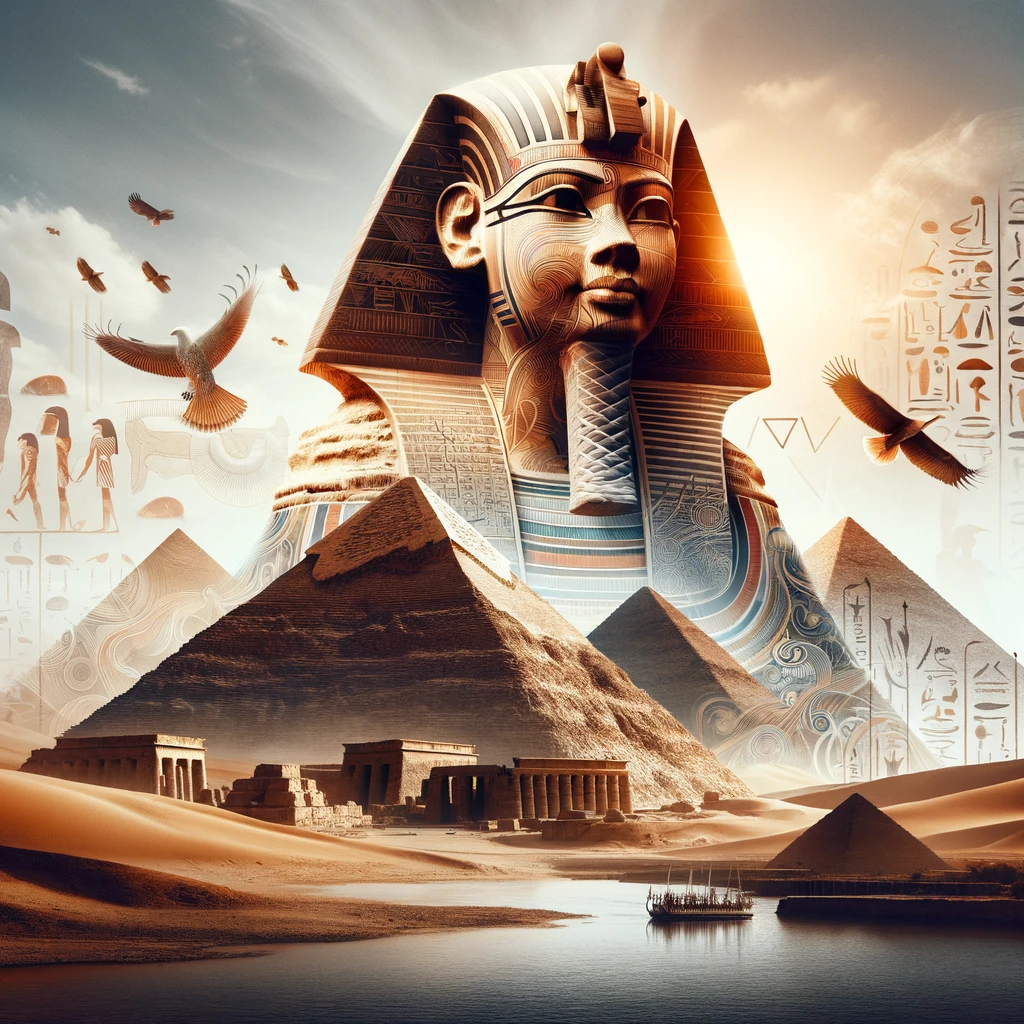
Nestled along the life-giving waters of the Nile River, Ancient Egypt stands as a beacon of human achievement in the vast expanse of history. For over three millennia, this civilization crafted a legacy that continues to mesmerize the world. From the awe-inspiring pyramids that touch the sky to the intricate art that captures the vibrancy of life, Egypt’s contributions are unparalleled.
Ancient Egypt was more than just pharaohs and monumental architecture; it was a crucible of innovation and knowledge. The civilization’s advancements in science, including medicine and astronomy, laid the groundwork for future generations. Hieroglyphics, Egypt’s sacred writing system, not only preserved their history but also provided a window into the daily lives, beliefs, and wisdom of the ancient Egyptians.
The governance system, with its highly organized bureaucratic structure, allowed for the management of vast resources and the undertaking of monumental construction projects that still stand as testaments to human ingenuity.
Ancient Egypt’s legacy is not just in the remnants of its physical achievements but in the enduring fascination and respect it commands. It serves as a timeless reminder of what humanity can accomplish when it harnesses the power of nature, creativity, and collective will.
Table of Contents
The Gift of the Nile
The Nile River, flowing through the heart of the desert, bestowed upon Egypt the precious gift of life, enabling one of history’s greatest civilizations to flourish. Ancient Egyptians called their land “Kemet,” or the black land, referring to the fertile black soil left behind by the Nile’s annual floods. This natural phenomenon was the cornerstone upon which Egyptian civilization was built.

The Nile’s Role in Egyptian Civilization
The Nile’s predictable flooding cycle was the lifeblood of Ancient Egypt, providing a reliable source of water and fertile land in an otherwise arid region. It facilitated the growth of crops such as wheat and barley, essential for food and beer, which were staples of the Egyptian diet. The river also served as a vital transportation route, connecting the various regions of Egypt and facilitating trade and communication.
Agriculture and Economic Structures
Agriculture was the backbone of Egypt’s economy, heavily reliant on the rhythm of the Nile. The annual floods rejuvenated the land, ensuring that farmers could harvest crops twice, and sometimes even three times a year. This abundance allowed Egypt to not only sustain a large population but also to accumulate wealth and resources.
The importance of agriculture led to the development of sophisticated irrigation techniques and the construction of canals to maximize the use of Nile’s waters. Such innovations demonstrate early Egyptians’ ingenuity and their ability to harness the environment for their benefit.
Social Structures and the Nile
The Nile’s blessings necessitated a high degree of social organization. The Pharaoh, viewed as a divine ruler, was responsible for the waters’ management and the fertility it brought. This belief system reinforced the Pharaoh’s central role in society and governance, underpinning the entire social hierarchy and political structure of Ancient Egypt.
Communities along the Nile were tightly knit, with a labor force organized around the agricultural cycle. The surplus produced by this efficient agricultural system supported not only farmers but also a class of artisans, scribes, and officials, fueling the development of Egyptian culture, art, and administration.
In essence, the Nile River was not just a physical feature of the landscape; it was the defining element of Egyptian civilization. Its annual floods were a clock and calendar, a source of sustenance, and a creator of landscapes, deeply influencing the economic, social, and religious life of Ancient Egypt. The civilization that emerged on its banks is a testament to human resilience and adaptability, a civilization that, to this day, owes its existence to the gift of the Nile.
Dynasties and Pharaohs: The Rulers of Egypt
The tapestry of Ancient Egyptian history is woven through its dynastic system, where pharaohs, regarded as gods on Earth, ruled over the land of the Nile. This concept of divine kingship placed the pharaoh at the apex of society, imbuing their reign with religious significance and absolute authority. Over the course of three millennia, Egypt was shaped by the hands of its rulers, from monumental constructions that reach for the heavens to pivotal reforms that altered the course of its history.

Divine Kingship and the Dynastic System
Ancient Egypt’s history was divided into periods known as dynasties, each a succession of rulers from the same family. The pharaoh was more than just a king; they were a mediator between the gods and humans, responsible for maintaining ma’at, or cosmic order, which was essential for the prosperity and harmony of the country. This divine kingship justified the pharaoh’s rule and legitimized their control over the land and its people.
Significant Pharaohs and Their Legacies
Khufu (Cheops)
- Reigning during the Fourth Dynasty of the Old Kingdom, Khufu is immortalized by the Great Pyramid of Giza, one of the Seven Wonders of the Ancient World. This colossal structure reflects his power and the sophisticated engineering skills of the ancient Egyptians.
Hatshepsut
One of the few female pharaohs, Hatshepsut ruled during the Eighteenth Dynasty, emphasizing trade and building projects over military conquests. Her reign is marked by the construction of her majestic mortuary temple at Deir el-Bahri, showcasing her ambition and the prosperity of her reign.
Akhenaten
Akhenaten is perhaps best known for his religious revolution. During the Eighteenth Dynasty, he shifted Egypt’s worship from the traditional pantheon of gods to the worship of Aten, the sun disk, fundamentally changing Egyptian religion and art during his reign. The city of Amarna was built to honor Aten, serving as the capital during his radical reforms.
Tutankhamun
Although he became pharaoh at a young age and died by nineteen, Tutankhamun is one of the most famous Egyptian pharaohs, primarily because of the discovery of his nearly intact tomb in the Valley of the Kings in 1922. His reign saw the restoration of the traditional Egyptian religion and pantheon, reversing the changes implemented by his predecessor, Akhenaten.
These rulers, among others, crafted the narrative of Ancient Egypt’s glorious past, leaving behind a legacy that has endured through millennia. Their monuments, reforms, and stories continue to captivate the imagination, offering insight into the profound impact these divine rulers had on the development of one of the greatest civilizations in human history.
Gods and Religion in Everyday Life
The spiritual landscape of Ancient Egypt was rich and diverse, rooted in a polytheistic belief system that permeated every aspect of daily life. The Egyptians worshipped a vast pantheon of gods and goddesses, each embodying elements of the natural world, societal concerns, and human emotions. This deep religious culture influenced everything from architectural feats to personal practices, underscoring the importance of the divine in the life of ancient Egyptians.

The Pantheon of Gods
Ra (Re)
Ra was the sun god, one of the most important deities, representing sunlight, warmth, and growth. Every morning, Ra was believed to be reborn in the east and sailed across the sky in his boat, setting in the west at dusk. The great pyramids aligning with the sun’s rays were seen as stairways to heaven, helping the pharaohs ascend to join Ra in the afterlife.
Osiris
Osiris, god of the afterlife, resurrection, and fertility, played a central role in Egyptian mythology. His story of death and rebirth was a powerful symbol of the afterlife’s promises and the agricultural cycle’s renewal. Osiris was the judge of the dead, and his cult emphasized the belief in moral integrity and the possibility of life after death.
Isis
Isis was worshipped as the ideal mother, wife, and the magic protector of children and the dead. Her devotion to her husband, Osiris, and her son, Horus, set her apart as a deity of great compassion and healing. Isis’s cult spread far beyond Egypt’s borders, testament to her universal appeal.
The Afterlife and Mummification
The ancient Egyptians’ belief in the afterlife was profound, shaping their rituals and cultural practices. Mummification, the preservation of the body, stemmed from the belief that the soul, or ka, needed a physical vessel in the afterlife. This intricate process, coupled with the grave goods and spells from the “Book of the Dead,” was designed to protect and guide the deceased in the afterlife.
The Role of Temples
Temples were the nexus of religious activity in Ancient Egypt, serving as the homes of gods and goddesses on earth. These sacred spaces were centers of worship, economic activity, and learning. Priests performed daily rituals to care for the gods’ statues, which were believed to house their divine essence. Temples also functioned as storerooms for offerings and wealth accumulated by the gods, redistributing resources in times of need and reinforcing the bond between the divine and the mortal world.
In every facet of Ancient Egyptian society, religion was a constant presence, guiding ethical behavior, shaping political authority, and providing hope for an eternal existence beyond mortal life. The gods and goddesses, rituals, and temples of Ancient Egypt offer a window into a world where the divine infused every stone, every grain of sand, and every heartbeat.
Monumental Achievements: Pyramids and Architecture

The architectural legacy of Ancient Egypt stands as a testament to its civilization’s ingenuity, ambition, and profound understanding of mathematics and astronomy. Among these achievements, the pyramids, especially the Great Pyramid of Giza, and the grand temples at Karnak and Luxor, along with the secretive tombs in the Valley of the Kings, underscore the Egyptians’ architectural brilliance and their dedication to their gods and the afterlife.
The Pyramids: Engineering Wonders
The pyramids are the most iconic symbols of Ancient Egypt, primarily serving as monumental tombs for pharaohs. The Great Pyramid of Giza, built for Pharaoh Khufu around 2580–2560 BC, is the most awe-inspiring. Originally standing at 146.6 meters (481 feet) tall, it was the tallest man-made structure in the world for over 3,800 years. Constructed from millions of limestone blocks, each weighing an average of 2.5 tons, the pyramid’s precise alignment with the cardinal points and its near-perfect base level showcase the Egyptians’ advanced engineering and astronomical knowledge.
Temples at Karnak and Luxor
The temples at Karnak and Luxor are magnificent expressions of religious devotion and royal authority. The Karnak Temple Complex, dedicated to the Theban triad of Amun, Mut, and Khonsu, was developed over more than a thousand years. Its vast array of decayed temples, chapels, pylons, and other buildings is the largest religious building ever constructed. The Temple of Luxor, connected to Karnak by an avenue of sphinxes, was a center of the Opet festival, where the gods Amun and Min were honored. These temples were not only places of worship but also served as economic hubs, supporting a vast network of priests, craftsmen, and laborers.
The Valley of the Kings
The Valley of the Kings, situated on the west bank of the Nile opposite Luxor, was a burial ground for pharaohs and powerful nobles of the New Kingdom (18th to the 20th Dynasties). This site, chosen for its seclusion and security, houses 63 tombs and chambers, ranging from simple pits to elaborate tombs with over 120 chambers. The most famous of these is the tomb of Tutankhamun, discovered in 1922 virtually untouched, offering invaluable insights into the material wealth and artistic achievements of the time.
These monumental achievements reflect not just the Ancient Egyptians’ architectural prowess but also their deep religious beliefs, their social and political organization, and their place in the natural world. The pyramids, temples, and tombs of Egypt are enduring symbols of a civilization that continues to fascinate and inspire, a bridge to a past where humans reached for immortality through stone and art.
Writing, Science, and the Arts in Ancient Egypt
Ancient Egypt’s contributions to writing, science, and the arts are as monumental as their architectural achievements, showcasing a civilization rich in innovation, creativity, and intellectual pursuit.

The Development of Hieroglyphics
Hieroglyphics, Egypt’s sacred script, were more than just writing; they were an art form, a way to immortalize the deeds of kings and gods. Developed around 3200 BC, hieroglyphics were used for religious texts, official inscriptions, and monumental art, employing a complex system of pictorial symbols that conveyed both sounds and ideas. This script allowed the Egyptians to record their history, culture, and religious beliefs in stone and papyrus, offering invaluable insights into their civilization for future generations.
Advances in Science
Medicine: The Egyptians were pioneers in medicine, utilizing a blend of empirical observation and magical practices. The Ebers Papyrus, dating back to around 1550 BC, contains over 700 remedies and diagnostic observations, evidencing their understanding of ailments and treatments. Egyptian physicians were skilled in surgery, dentistry, and the preparation of medicinal compounds, setting the foundation for modern medicine.
Astronomy: Egyptian astronomy was closely linked to their religious and agricultural practices, with the stars playing a crucial role in the timing of the Nile’s flooding and religious festivals. They developed a calendar system based on the lunar and solar cycles, introducing the 365-day year that is still in use today.
Mathematics: The need to predict the Nile’s flooding, construct monumental architecture, and allocate land for agriculture led to significant advances in mathematics. The Rhind Mathematical Papyrus illustrates their use of arithmetic, geometry, and algebra in solving practical problems, including calculating areas and volumes.
Artistic Achievements
The art of Ancient Egypt, characterized by its order, beauty, and symbolism, was primarily intended to serve religious and political purposes.
Sculptures, both monumental and small-scale, were idealized representations of gods, pharaohs, and the nobility, intended to provide eternal life.
Painting, with its conventional use of color and form, adorned tomb walls and temples, depicting scenes of daily life, religious rituals, and the journey to the afterlife. Literature, including the Pyramid Texts, the Book of the Dead, and love poetry, explored themes of creation, morality, and the afterlife, reflecting the Egyptians’ beliefs and values.
The legacy of Ancient Egypt in writing, science, and the arts is a testament to their quest for knowledge, beauty, and understanding of the world around them. This rich cultural heritage continues to influence and inspire, a reminder of the enduring power of human creativity and intellect.
Daily Life in Ancient Egypt

The daily life of Ancient Egyptians was intricately tied to the land, the Nile, and a complex web of social hierarchies and religious beliefs. This structured society was built around agriculture, craftsmanship, and trade, with each individual playing a vital role in the civilization’s sustenance and growth.
Social Hierarchy
Ancient Egyptian society was highly stratified, with the Pharaoh at the top as the divine ruler and intermediary between the gods and the people.
Below the Pharaoh were high officials, priests, and nobles who managed the land, the state’s wealth, and religious ceremonies.
Middle-class scribes, artisans, and craftsmen followed, responsible for creating the goods and artworks that Egypt is famed for.
At the base of the hierarchy were the farmers and laborers, the backbone of the Egyptian economy, who worked the land and built the monumental structures that define Ancient Egypt today.
Slaves and servants, often prisoners of war or those in debt, also played roles in this complex societal structure.
Family Life and Daily Activities
Family was central to Egyptian society, with marriage and children being highly valued. Most Egyptians lived in simple mud-brick homes, with family life revolving around agricultural cycles and religious observances. Daily life for the average Egyptian involved working the fields, crafting goods, or trading in the marketplaces. Leisure activities included music, board games like Senet, and festivals tied to religious or agricultural events.
Diet consisted mainly of bread, beer, and onions, supplemented with vegetables, fish, and occasionally meat. Clothing was made from linen, suitable for the hot climate, with styles varying according to social status.
The Economy: Farmers, Craftsmen, and Merchants
Farmers: The economy of Ancient Egypt was predominantly agricultural, with the majority of Egyptians engaged in farming. They grew crops such as wheat, barley, vegetables, and flax, relying on the Nile’s annual floods to irrigate the fields. The surplus supported not only the local population but also the state’s projects and external trade.
Craftsmen: Skilled craftsmen worked in workshops, producing goods ranging from pottery and jewelry to elaborate tomb decorations and religious items. Craftsmen were organized into guilds and often worked on state-sponsored projects, such as temple decorations or royal commissions.
Merchants: Trade was vital for acquiring resources not available in Egypt, such as cedar from Lebanon and gold from Nubia. Merchants facilitated this trade, traveling across deserts and seas to exchange Egyptian goods for those of neighboring lands. They played a crucial role in bringing luxury items to the Egyptian elite and raw materials for artisans.
Daily life in Ancient Egypt was a tapestry of hard work, religious devotion, and communal activities, set against the backdrop of the Nile’s ebb and flow. This rhythm of life, guided by the river and the gods, created a civilization that was incredibly advanced for its time, leaving a legacy that continues to fascinate.
Conclusion: Egypt’s Legacy and Influence
The civilization of Ancient Egypt has left an indelible mark on history, shaping the cultural, intellectual, and technological landscapes of subsequent civilizations and continuing to captivate modern society. Its legacy is a testament to the ingenuity and spirit of its people, whose achievements have inspired countless generations.
Impact on Subsequent Cultures
The influence of Ancient Egyptian civilization can be seen across a broad spectrum of domains, from art and architecture to science and governance. Greek and Roman cultures, among others, were profoundly influenced by Egyptian thought and practices. The concept of monumental architecture, as epitomized by the pyramids and temple complexes, inspired classical and later architectural styles. Egyptian advancements in medicine were documented by Greek historians and continued to be used through the Middle Ages. Moreover, the religious and mythological motifs of Egypt found echoes in Greek and Roman deities and stories, illustrating the deep cultural exchange between these civilizations.
Modern Society and Egyptology
The fascination with Ancient Egypt in modern times, known as Egyptomania, has permeated various aspects of culture and scholarship. The field of Egyptology, the study of Ancient Egyptian history, language, and culture, emerged in the 19th century following the decipherment of hieroglyphics through the Rosetta Stone. This academic discipline has unveiled vast amounts of knowledge about the ancient world, influencing fields as diverse as archaeology, anthropology, and history.
The aesthetic and symbolic aspects of Egyptian art have inspired movements in modern art and architecture, while its motifs are prevalent in literature, cinema, and fashion. The allure of Egypt’s mysteries, such as the construction techniques of the pyramids or the beauty of the hieroglyphic script, continues to intrigue scientists and laypeople alike, driving ongoing research and exploration.
Egyptology and Public Fascination
Public interest in Ancient Egypt is fueled by both its profound mysteries and the tangible connections it offers to humanity’s shared past. Exhibitions of Egyptian artifacts draw millions of visitors worldwide, while the stories of pharaohs and deities are retold in books, movies, and other media. This enduring fascination underscores the universal appeal of Egypt’s heritage, bridging the gap between the ancient and the modern.
Ancient Egypt’s legacy is not merely a collection of monumental ruins and artifacts but a living influence that continues to shape our understanding of human history, culture, and achievement. The civilization’s contributions to the arts, sciences, and the very concept of civilization itself remain relevant, underscoring the enduring significance of Egypt in the tapestry of human heritage.
Related Content:
Ancient Civilizations Timeline: A Beginner’s Overview
Unearthing Mesopotamia: Cradle of Civilization
Self Assurance: Steps to Boost Self-Assurance
Commonly Asked Questions
Ancient Egypt is generally considered to have started around 3100 BC with the unification of Upper and Lower Egypt under the first pharaoh, Narmer (also known as Menes). This event marks the beginning of the Pharaonic period and the start of the First Dynasty, leading into the early stages of the Old Kingdom.
The ancient history of Egypt is divided into several periods and dynasties, spanning over three millennia. Following the initial unification, the Old Kingdom (circa 2686–2181 BC) saw the construction of the first pyramids and the development of a centralized state. The Middle Kingdom (circa 2055–1650 BC) was a time of reconsolidation of power, cultural flourishing, and expanded trade. The New Kingdom (circa 1550–1070 BC) was Egypt’s imperial age, during which it reached its peak in wealth, power, and territory. This was followed by periods of decline and foreign rule, including the Late Period, Persian conquest, and eventually the conquest by Alexander the Great in 332 BC, which marked the end of ancient Egypt’s pharaonic period. The Ptolemaic Dynasty, established by one of Alexander’s generals, lasted until the Roman conquest in 30 BC.
- Ancient Egypt, from the beginning of the Pharaonic period around 3100 BC to the end of the Ptolemaic Dynasty with the Roman conquest in 30 BC, lasted for approximately 3,070 years. This extensive timeline encompasses a rich tapestry of development in governance, art, architecture, and society, making it one of the longest-lasting civilizations in human history.



Leave a Reply